Retail Investor Access to Private Market Assets: What the SEC’s IAC Report Means for Interval Funds
The SEC’s Investor Advisory Committee (IAC) has issued a set of recommendations under the banner “Retail Investor Access to Private Market Assets.” While advisory in nature, the report marks a turning point in the ongoing debate about whether and how retail investors should participate in private equity, credit, venture capital, and real estate.
For interval funds—already one of the fastest-growing vehicles for bridging private markets with retail portfolios—the implications are profound. The IAC’s recommendations not only validate the structure but also point toward potential reforms that could expand its utility and reshape the competitive landscape.
Interval Funds as the Preferred Access Vehicle
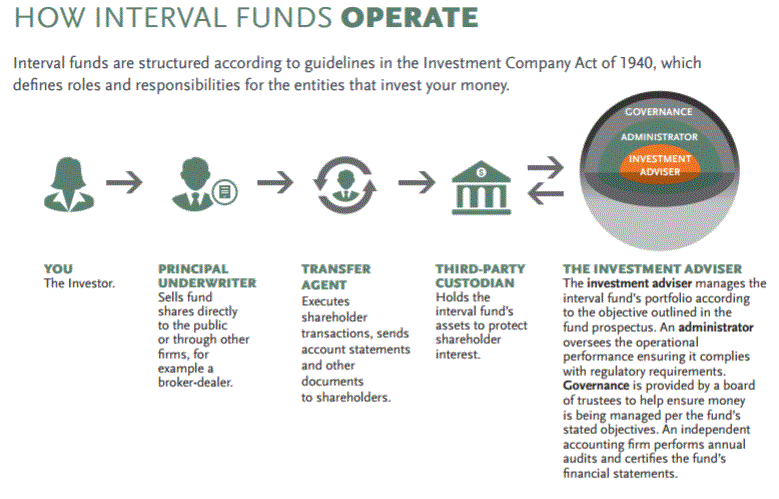
The IAC’s top-line message is clear: if retail investors are to access private markets, it should be primarily through registered fund structures that offer regulatory oversight and investor protections. Interval funds sit at the center of that vision. Unlike private funds, interval funds are subject to the 1940 Act, which imposes board oversight, audited financials, limits on leverage, and regular disclosure. Yet unlike open-end mutual funds, they can hold illiquid assets by limiting redemptions to periodic repurchase offers.
For sponsors, this endorsement reinforces that interval funds are not a niche experiment but a policy-backed solution to the demand for broader access to private markets.
Key Recommendations That Target Interval Funds
- Liquidity Reform: Toward Monthly Repurchases
The IAC recommends amending Rule 23c-3 to permit monthly redemptions, in addition to the current quarterly or semi-annual cadence. If implemented, this could transform the appeal of interval funds for advisors and platforms, making them easier to slot into client portfolios. But it also raises the stakes for liquidity management, requiring careful portfolio construction, stress testing, and robust credit lines or secondary-market strategies to handle flows. - Valuation Standards and Oversight
Interval funds face heightened scrutiny on how they mark illiquid holdings. The IAC calls for enhanced disclosures around valuation methodologies and more rigorous board oversight. For managers, this likely means expanded documentation, independent valuation providers, and clearer communication in shareholder reports. - Multi-Class and Series Structures
Codifying multi-class share structures and permitting closed-end series funds could reduce costs and increase flexibility. Interval funds could be launched under umbrella trusts with multiple strategies, lowering operational barriers and accelerating product development. - Co-Investment Opportunities
The IAC suggests codifying co-investment relief, allowing interval funds to participate alongside affiliated private funds. This could broaden deal flow and make retail vehicles more competitive with institutional platforms, provided conflicts of interest are carefully managed. - Layered Disclosures
The committee also urges simplified, standardized disclosure formats to help investors understand complex strategies. Interval funds will need to adapt marketing and prospectus language into plainer, more comparable terms.
Growth Opportunities for Interval Funds
If these recommendations lead to rulemaking, interval funds could become the dominant gateway for retail investors into private markets. Expanded liquidity windows, streamlined structures, and standardized disclosures would make them more attractive to broker-dealers, RIAs, and platforms. Managers with established interval fund platforms could capture significant first-mover advantages, while new entrants may find it easier to launch competitively priced products.
The thematic fit is strong:
Private credit interval funds could serve the yield-seeking retail base.
Diversified multi-strategy interval funds could emerge under series structures.
Lower minimums and clearer disclosures could open the door to mass-affluent adoption.
Risks to Watch
With growth comes risk. The biggest challenges include:
- Liquidity mismatches if investors expect faster exits than underlying assets can support.
- Reputational risk if valuations are perceived as inflated or inconsistent.
- Operational and compliance burdens as regulators raise the bar for oversight and reporting.
- Regulatory uncertainty if dissenting voices at the SEC prevail in curbing expansion.
The Bottom Line
The IAC’s recommendations, coupled with recent SEC staff moves to ease restrictions on retail closed-end funds, point toward a larger role for interval funds in the U.S. capital markets. For fund sponsors, the message is twofold: interval funds are here to stay, and the expectations around transparency, liquidity management, and governance are about to rise. It represents both a growth opportunity and a compliance challenge that will demand strategic investment in infrastructure, risk management, and investor communication.
Additional Tools and Resources
For comprehensive competive intelligence on the unlisted CEF industry, sign up for a Premium Plus Membership.
To access the industry’s most complete dataset covering NT BDCS, NT REITs and Opcos, sign up for Alternative.Investments Pro. Its an essential resource for anyone involved in product development, investment research, or due diligence within the retail alts space.
We also have a lot of data available for free:
- Complete list of all active interval funds
- Complete list of all active tender offer funds
- Non-traded REITs
- Non-traded BDCs
- Conglomerates, Opcos, and other alternative funds.
Interested in advertising on or Alternative.Investments or Interval Fund Tracker? email [email protected] to learn about partnership opportunities.
Holding alternative investment funds that you need to exit quickly? We also have liquidity solutions for unlisted securities