Interval Fund Tracker
  • Home
  • Research
    • Credit
    • Equity
    • Insurance Linked Securities
    • Multistrategy
    • Private Equity & Venture Capital
    • Real Estate
    • Blog
  • Premium
  • Tools and Data
    • Premium Data
    • New Interval Fund Registrations and Launches
    • Active Interval Funds
    • Tender Offer Funds
    • Non-traded REITs
    • Non-traded BDCs
  • About
    • Contact
    • Advertise
  • Log In
Real Estate Interval Funds

Real Estate Interval Funds

September 24, 2017

Real estate interval funds are an important option for investors looking for a liquidity compromise between publicly listed REITs and private funds. David Blatt of Capstack Partners wrote recently about the use of interval funds as a way of providing more investors access to direct real estate investing:

Recently, investment management firms have begun to take advantage of the interval fund to access retail capital for real estate investments. The attractive features of the interval fund that are more conducive to individual investors are the low required investment minimums, and the transparency afforded by SEC reporting requirements. But that’s not all. Real estate focused interval funds also offer exposure to a wide range of investments including listed, non-listed, public and nonpublic investments. Altogether, these features create a means by which retail investors and their financial advisors can access higher quality/higher return alternative investments in real estate.

When one considers the pace of evolution in the real estate investment industry, one can correlate the recent acceleration of new and repurposed investment vehicles to growing interest in the asset class – REITs gained popularity in 1990s, CMBS over the 2000s, private equity funds in the last decade, and more recently, growing retail investor interest in real estate that led to the interval fund. This evolution is a reminder that while real estate is generally a high priced, slow moving, fixed asset, the groups investing in real estate remain creative and resilient in the ways they structure the investments to access its rewards, while mitigating its risks. It makes for exciting times ahead for the space.

Institutional Real Estate

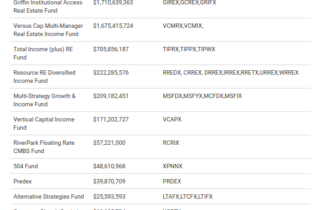
According to to Interval Fund Tracker’s data, 11 active interval funds with a combined total of $4.8 billion in assets focus on real estate. The three largest funds account for about 84% of the AUM in real estate interval funds, including Griffin Institutional Access Real Estate Fund, Versus Capital Multi-Manager Real Estate Income Fund, and BlueRock Total Income (Plus) RE Fund. Also note, that many diversified interval funds such as the Multi Strategy Growth and Income Fund and the Wildermuth Endowment Strategy Fund, focus on real estate as part of a broader asset allocation strategy.
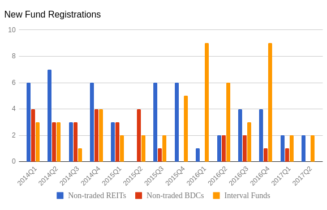

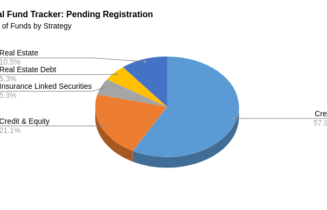
data on fund registratiosn indicates interval funds are a key source of credit products for retail investors.

The Next Evolution in Credit Products

September 17, 2017

The latest issue of Private Debt Investor includes an excellent article on interval funds in the broader context of credit products for investors.   The article cites data from Interval Fund Tracker, and includes interviews with several interval fund managers. It notes that interval funds are able to provide enhanced  yield while providing quarterly liquidity.   Additionally, the article discusses the role of credit interval funds in asset allocation.

According to Brook Taube at Medley Management(manager of Sierra Total Return Fund):

Access to private credit can help satisfy investors’ demand for yield. The fact that the [interval] fund offers liquidity on a quarterly basis makes it an attractive structure for retail investors.

According to Michael Reisner, co-chairman and co-chief executive at CION(manager of the Cion Ares Diversified Credit Fund):

If you look at BDCs as sector-specific products – eg, US mid-market – credit interval funds like ours are more diversified and a core holding, and should be the next evolution in credit products.

According to Marc Yaklofsky, senior vice-president and spokesman at FS Investments(manager of the FS Total Return Fund):

Versus Capital Real Assets Interval Fund

Versus Capital Launches Another Interval Fund

August 27, 2017

The Versus Capital’s new real assets interval fund was declared effective by the SEC on August 17, 2017. Versus Capital Real Assets Fund, LLC is seeking to raise $450 million in a continuous offering. Minimum initial investment is $10 million(RIAs can aggregate accounts to get to the minimum). The fund will have one share class. and the management fee will be 1.50% of net assets.

Versus Capital is familiar with the interval fund space. It also manages Versus Capital Multi-Manager Real Estate Income Fund LLC, an investment company with $1.7 billion in assets. See Active Interval Funds for more information on this fund.

Closed End Funds, Mutual Funds, and Interval Funds

The Investment Company Act of 1940: 77 Years Later

August 23, 2017

On this day in 1940, President Roosevelt signed the Investment Company Act of 1940.  Previously, both houses of congress had approved the ’40 Act unanimously. The ’40 Act, is the primary source of regulations for the multi-trillion dollar investment industry. The ’40 act defined and regulated investment companies, and provides investors with protections against conflicts of interest, misappropriation of funds, excessive fees, and undisclosed risks.

As he signed the bill, President Roosevelt declared:

We have come a long way since the bleak days of 1929…. I have great hopes that the act which I have signed today will enable the investment trust industry to fulfill its basic purpose as a vehicle to diversify the small investors risk.

What is a ’40 Act Fund?

The investment companies that the 1940 Act protections apply to are known as 1940 Act Funds, or ’40 Act Funds Broadly speaking, there are three types of  ’40 Act Funds: Closed End Funds, Open End Funds, and Unit Investment Trusts. Open end funds and closed end funds are the most common type of

Interval Fund Transfer Agents

Interval Fund Service Providers

August 21, 2017

Interval funds rely on a variety of third party fund service providers in order to operate.  An administrator oversees the operational performance ensuring it complies with regulatory requirements. An independent accounting firm performs annual audits and certifies the fund’s financial statements. The interval fund transfer agent keeps ownership records, and handles transaction processing. A CSV file with information on service providers for all active interval funds is available at the bottom of this post.

Interval Fund Transfer Agent Market Share

Several users of this site have asked about interval fund transfer agents. DST Systems leads the market, and currently serves as transfer agent for 26% of active interval funds.  See this whitepaper that DST Systems recently produced on exploring new product structures. UMB Services serves as transfer agent for 21% of interval funds. UMB Services recently wrote about its turnkey interval fund solutions in HedgeWeek.

The following chart summarizes interval fund transfer agent market share, as of August 2017:


Interval Fund Transfer Agents

«‹ 17 18 19 20›»

Interval Fund Updates

Back to Top

  • Terms of Service
  • Privacy Policy
  • Advertise
  • Contact
© 2024 Diligent Research LLC